
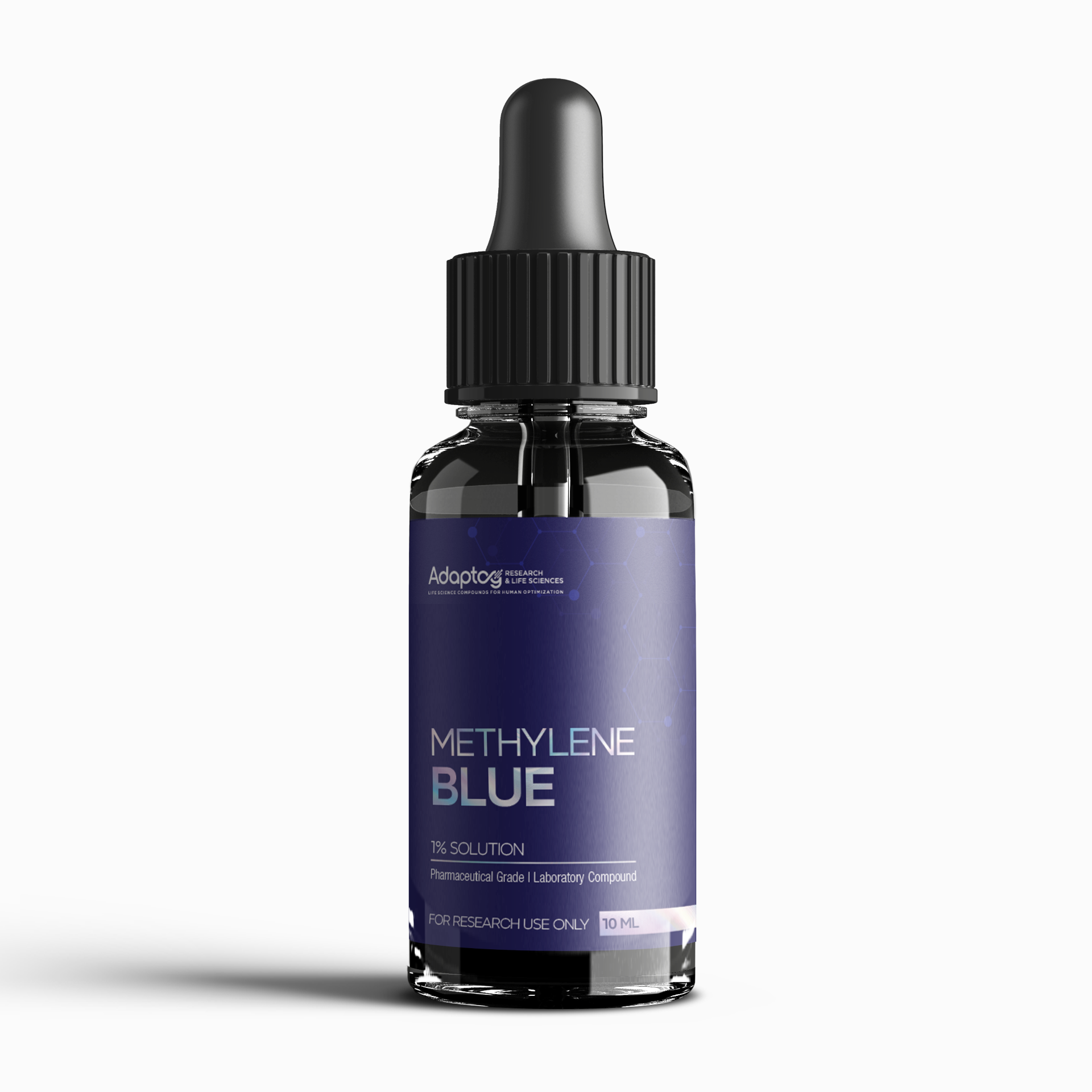


Description
Disclaimer: The following product is strictly intended for authorised research only.
Methylene blue (MB) is a synthetic compound that was originally synthesised in 1876 and used as a dye by the textile industry. It was later discovered that this compound had antimalarial properties and could be used to treat methemoglobinemia. More recently, it has been reported to exert several health benefits related to mitochondrial health and ageing.
Mechanism of Action
There are several mechanisms by which MB can exert changes in the body, including:
- Inhibition of monoamine oxidase (MAO): MB increases serotonin in the brain by acting as a potent, reversible monoamine oxidase inhibitor. It strongly inhibits MAO A and can also inhibit MAO B at higher concentrations.1
- Guanylyl cyclase inhibition: MB can cause contraction of the arteries by inhibiting guanylyl cyclase,2 an enzyme which plays an important role in the relaxation of the cardiac muscle.3
- Activation of Nrf2: Nrf2 regulates the cellular redox state. Activating it results in the production of antioxidant molecules and anti-inflammatory effects.4
- Bypassing complex I/II in the mitochondria: The mitochondrial complexes responsible for transporting electrons can become damaged, leading to an overproduction of ROS, increased oxidative damage and cellular damage. When damaged complexes are bypassed, this helps to reduce oxidative stress.5
- Inhibition of glutathione reductase: MB is effective against several Plasmodium species.6 Part of its antimalarial activity is due to its ability to inhibit glutathione reductase, an enzyme produced by the parasite and which is essential for it to thrive.7
- Reduction of methaemoglobin (MetHb): MB is reduced to leucomethylene blue, which acts as an electron donor, reducing MetHb to haemoglobin.8
- Transfer of energy to ROS: Upon exposure to light of certain wavelengths, it transfers energy to ROS and generates a singlet oxygen capable of causing oxidative damage.9,10
Therapeutic Potential
Because of these mechanisms, it has several potential medical uses and has been investigated for its use as a treatment for:
- Depression: MAO inhibitors are a class of drugs used to treat depression and Parkinson’s disease. Since MB also inhibits MAO, it could also act as an antidepressant compound.11 One study found that it significantly reduced symptoms of depression and anxiety in those with bipolar disorder.12
- Hypotension induced by septic shock: The inhibition of guanylyl cyclase causes arteries, as well as other tissues, to contract. In cases of septic shock where blood pressure drops dangerously low, this can help raise blood pressure and improve survival in animal models.13,14
- Toxicity in various tissues: The activation of Nrf2 means that cells exposed to toxins that would cause oxidative stress have improved survival due to the antioxidant and protective effect of MB on the mitochondria.15,16 The ability of MB to bypass complex I/II also helps to reduce oxidative stress, as shown by a study on diabetic rat hearts17 and another study on liver damage induced by toxins.18
- Osteoarthritis: The reduction in oxidative stress may improve the symptoms of osteoarthritis. A study on osteoarthritis rat models found that MB reduced oxidative stress, slowed the progression of the disease and reduced pain.19
- Cognitive decline: MB has been found to improve symptoms of neurodegeneration in models of stroke, global cerebral ischemia, Alzheimer’s disease, Parkinson’s disease and traumatic brain injury.20
- Malaria: MB has been used to prevent and treat malaria, and has been found to reduce oocyst count by 1,438-fold.21
- Methemoglobinemia: Because MB can reduce MetHb to haemoglobin, it has been used to treat methemoglobinemia with much success.22
- Bacterial infections: MB is a photosensitiser. This property has been explored as a way to treat bacterial infections. MB in combination with light therapy has been found to kill bacteria due to the oxidative damage it causes.23
- Cancer: The photosensitising property of MB could potentially be used for cancer treatments. Cancer cells that have taken up MB, when exposed to red light, experience oxidative damage and cell death. Results from studies on animals appear to be promising.10,24
MB has several beneficial effects which have been explored by researchers. Because of the mechanism by which MB exerts its effects, it must be used cautiously, as excessive dosing can lead to harm.
Safety
When used with other drugs that affect serotonin or which have MAO inhibitory activity, there is a risk of inducing serotonin syndrome due to the strong effect of MB on MAO and its combined effect with these other drugs.
MB inhibits guanylyl cyclase, causing contraction of arteries. This can lead to an increase in blood pressure or hypertension with high doses. This vasoconstrictive activity could potentially promote or exacerbate erectile dysfunction.
Although MB can be used to treat methemoglobinemia, it can also cause the condition as it acts as an oxidising agent at higher concentrations.8
Since MB acts as a photosensitiser, skin may be more sensitive to light after administration. This is demonstrated by a case study involving infants prenatally exposed to high doses of MB who received phototherapy.25
How It Compares to NAD+
Both MB and NAD+ are thought of as anti-ageing compounds.
MB is synthetic and works by enhancing mitochondrial function and promoting the production of antioxidant molecules. It has the potential to exert broad benefits, including MAO inhibition. Because of its oxidative activity at higher concentrations and upon exposure to light, as well as its potential drug interactions, it should be used with caution. MB’s use as an anti-ageing compound is not supported by much research and is still experimental.
NAD+ is a naturally occurring coenzyme involved in redox reactions and plays a vital role in energy metabolism. It is also involved in the functioning of several other important enzymes, such as sirtuins and CD38. It influences metabolic pathways, DNA repair, cellular senescence and the functioning of the immune system. The adverse events associated with NAD+ infusion include moderate to severe gastrointestinal symptoms, increased heart rate and chest pressure, tingling and cramping26. NAD+ has a well-established role in the maintenance of proper cellular function, although evidence supporting its efficacy as a supplement is lacking.
The mechanisms by which these compounds work could potentially improve aspects of cellular function that tend to decline with age. Since they affect different aspects of cellular health, their benefits have the potential to be complementary.
Data Sheet
| Application | Research on mitochondrial function, ageing, neurodegenerative disease, inflammation and depression. |
| Pack Sizes | 1% solution |
| CAS Number | 61-73-4 |
| Molecular Weight (g/mol) | 319.85 |
| Chemical Formula | C16H18ClN3S |
| Synonyms | Methylthioninium chloride, 3,7-bis(Dimethylamino)phenothiazin-5-ium Chloride, 3,7-bis(Dimethylamino)phenothiazin-5-ium Chloride, Methylene blue |
| Storage | Store at 15–25°C in a cool, dry place. Keep out of direct sunlight. |
| Organoleptic Profile | Clear, deep blue solution |
| Physical Form | Liquid |
Conclusion
Methylene blue has been used in medicine as an anti-malarial for over a century and as a treatment for methemoglobinemia for decades. New uses for this compound have emerged, and it is now being investigated as a treatment for depression and neurodegeneration, to regulate blood pressure, reduce oxidative damage, and enhance mitochondrial function. Careful dosing is required to avoid problems such as serotonin syndrome, hypertension and photosensitivity.
References
- Ramsay RR, Dunford C, Gillman PK. Methylene blue and serotonin toxicity: inhibition of monoamine oxidase A (MAO A) confirms a theoretical prediction. Br J Pharmacol. 2007;152(6):946-951. doi:10.1038/sj.bjp.0707430
- Farina Junior JA, Celotto AC, Da Silva MF, Evora PRB. Guanylate cyclase inhibition by methylene blue as an option in the treatment of vasoplegia after a severe burn. A medical hypothesis. Med Sci Monit. 2012;18(5):HY13-HY17. doi:10.12659/MSM.882718
- Pirahanchi Y, Dimri M. Biochemistry, Guanylate Cyclase. In: StatPearls. StatPearls Publishing; 2026. Accessed July 22, 2026. http://www.ncbi.nlm.nih.gov/books/NBK537151/
- Bhurtel S, Bok E, Katila N, Kim J, Choi DY. Activation of Nrf2 by methylene blue is associated with the neuroprotection against MPP+ induced toxicity via ameliorating oxidative stress and mitochondrial dysfunction. Biochem Pharmacol. 2021;192:114719. doi:10.1016/j.bcp.2021.114719
- Xue H, Thaivalappil A, Cao K. The Potentials of Methylene Blue as an Anti-Aging Drug. Cells. 2021;10(12):3379. doi:10.3390/cells10123379
- Saison N, Franetich JF, Pinilla YT, et al. Rapid and Specific Action of Methylene Blue against Plasmodium Transmission Stages. Pharmaceutics. 2022;14(12):2794. doi:10.3390/pharmaceutics14122794
- Becker K, Rahlfs S, Nickel C, Schirmer RH. Glutathione–functions and metabolism in the malarial parasite Plasmodium falciparum. Biol Chem. 2003;384(4):551-566. doi:10.1515/BC.2003.063
- McDonagh EM, Bautista JM, Youngster I, Altman RB, Klein TE. PharmGKB summary: methylene blue pathway. Pharmacogenet Genomics. 2013;23(9):498-508. doi:10.1097/FPC.0b013e32836498f4
- Andres Garcia-Diosa J, Grundmeier G, Keller A. Highly Efficient Quenching of Singlet Oxygen by DNA Origami Nanostructures. Chem – Eur J. 2024;30(46):e202402057. doi:10.1002/chem.202402057
- Tardivo JP, Del Giglio A, de Oliveira CS, et al. Methylene blue in photodynamic therapy: From basic mechanisms to clinical applications. Photodiagnosis Photodyn Ther. 2005;2(3):175-191. doi:10.1016/S1572-1000(05)00097-9
- Delport A, Harvey BH, Petzer A, Petzer JP. Methylene blue and its analogues as antidepressant compounds. Metab Brain Dis. 2017;32(5):1357-1382. doi:10.1007/s11011-017-0081-6
- Alda M, McKinnon M, Blagdon R, et al. Methylene blue treatment for residual symptoms of bipolar disorder: randomised crossover study. Br J Psychiatry J Ment Sci. 2017;210(1):54-60. doi:10.1192/bjp.bp.115.173930
- Daemen-Gubbels CR, Groeneveld PH, Groeneveld AB, van Kamp GJ, Bronsveld W, Thijs LG. Methylene blue increases myocardial function in septic shock. Crit Care Med. 1995;23(8):1363-1370. doi:10.1097/00003246-199508000-00009
- Fernandes D, Sordi R, Pacheco LK, et al. Late, but not early, inhibition of soluble guanylate cyclase decreases mortality in a rat sepsis model. J Pharmacol Exp Ther. 2009;328(3):991-999. doi:10.1124/jpet.108.142034
- Ibrahim SG, Abu-Dief AM, Gad AM, et al. Methylene Blue Mitigates Doxorubicin-Induced Cardiotoxicity via KEAP1/NRF2/GPX-4/Caspase3 Modulation. Int J Mol Sci. 2025;26(16):7680. doi:10.3390/ijms26167680
- Samoylova NA, Gureev AP, Popov VN. Methylene Blue Induces Antioxidant Defense and Reparation of Mitochondrial DNA in a Nrf2-Dependent Manner during Cisplatin-Induced Renal Toxicity. Int J Mol Sci. 2023;24(7):6118. doi:10.3390/ijms24076118
- Duicu OM, Privistirescu A, Wolf A, et al. Methylene blue improves mitochondrial respiration and decreases oxidative stress in a substrate-dependent manner in diabetic rat hearts. Can J Physiol Pharmacol. 2017;95(11):1376-1382. doi:10.1139/cjpp-2017-0074
- Lee KK, Boelsterli UA. Bypassing the compromised mitochondrial electron transport with methylene blue alleviates efavirenz/isoniazid-induced oxidant stress and mitochondria-mediated cell death in mouse hepatocytes. Redox Biol. 2014;2:599-609. doi:10.1016/j.redox.2014.03.003
- Li J wei, Wang R liang, Xu J, et al. Methylene blue prevents osteoarthritis progression and relieves pain in rats via upregulation of Nrf2/PRDX1. Acta Pharmacol Sin. 2022;43(2):417-428. doi:10.1038/s41401-021-00646-z
- Tucker D, Lu Y, Zhang Q. From Mitochondrial Function to Neuroprotection-an Emerging Role for Methylene Blue. Mol Neurobiol. 2018;55(6):5137-5153. doi:10.1007/s12035-017-0712-2
- Chaumeau V, Wasisakun P, Watson JA, et al. Transmission-blocking activities of artesunate, chloroquine, and methylene blue on Plasmodium vivax gametocytes. Odom John A, ed. Antimicrob Agents Chemother. 2024;68(9):e00853-24. doi:10.1128/aac.00853-24
- Chen RJ, Nappe TM. Methemoglobinemia. In: StatPearls. StatPearls Publishing; 2026. Accessed July 22, 2026. http://www.ncbi.nlm.nih.gov/books/NBK537317/
- Klepac-Ceraj V, Patel N, Song X, et al. Photodynamic effects of methylene blue-loaded polymeric nanoparticles on dental plaque bacteria. Lasers Surg Med. 2011;43(7):600-606. doi:10.1002/lsm.21069
- Link EM, Michalowski AS, Rösch F. 211At-methylene blue for targeted radiotherapy of disseminated melanoma: microscopic analysis of tumour versus normal tissue damage. Eur J Cancer. 1996;32(11):1986-1994. doi:10.1016/0959-8049(96)00236-5
- Porat R, Gilbert S, Magilner D. Methylene blue-induced phototoxicity: an unrecognized complication. Pediatrics. 1996;97(5):717-721.
- Reyna K, Heinzen G, Patel N, et al. Intravenous infusion of nicotinamide adenine dinucleotide (NAD+) versus nicotinamide riboside (NR): a retrospective tolerability pilot study in a real-world setting. Front Aging. 7:1652582. doi:10.3389/fragi.2026.1652582
Linda küchler –
I’m in my late 40s and had been experiencing a mental haze that I attributed to just getting older. A friend recommended Methylene Blue. Within the first week, I noticed a clarity I hadn’t felt in years. By week three, the brain fog was completely gone. I can focus on complex tasks, remember details, and think more clearly. It’s been a profound change. One study found a low dose improved memory retrieval by 7% just one hour after administration, and I can believe it
Aumer Irhaim –
The Mental Clarity is Remarkable
Kimberly Perkins –
I Feel Like Myself Again
Faris –
The longer I use it, the better I feel. It’s not a quick fix—it’s a gradual improvement that builds over weeks and months. I’ve been taking it for about two months now and I’m feeling at least 10 years younger
heather laurel –
I’m getting more done in less time. My focus and energy are better. Methylene Blue has been a valuable tool for my career. I was more productive than normal and felt better than I normally do
Kelvin –
The standard dose didn’t do much for me. I had to increase it to see results. Everyone responds differently. I started low and kept going to see if I could notice anything.
Jason Owen –
I noticed an increase in libido, which has improved my relationship. It’s a welcome benefit. The MAOI effects on dopamine and serotonin may be responsible.
Elizabeth Ashton –
The improvements in my energy, mood, and mental clarity have boosted my confidence. I feel better about myself
Antonio G Short –
I feel more connected to my family and more engaged in my life. The brain fog has lifted and I’m actually present
Godfrey –
I’m in my 50s and my libido had declined. Methylene Blue has brought it back. The MAOI effects on dopamine may be responsible
Stacey M. –
The first few weeks I didn’t notice much. It took about a month before I really felt the difference. Once it kicked in, the energy and mental clarity improvements were noticeable. Patience is key
Jon Vasquez –
The antioxidant effects are supporting tissue repair
Melissa Seelig –
The longer I take it, the better I feel. It’s a gradual improvement that builds over weeks and months. I’ve been taking it for three months and I experience significant results
Debra K Wornell –
The anti-inflammatory effects have helped my joints. I’m moving more freely and with less discomfort. It’s a welcome addition to my joint health protocol.
Stephanie –
I have fewer mood swings and feel more emotionally balanced. Methylene Blue has helped stabilize my mood. I’ve noticed my social anxiety has diminished greatly
Jack Simob –
My Cognitive Function Improved
Donnielle Carter –
It’s not a dramatic, in-your-face effect. It’s a subtle improvement in energy and clarity that builds over time. But looking back, the difference is undeniable. I’m functioning at a higher level. The effects were somewhat subtle yet also significant for me
Matt –
The mental clarity I get from Methylene Blue is remarkable
David Manevich –
My Workouts Feel Easier
Ming Wang –
I’ve struggled with sleep for a decade. I’d fall asleep fine but wake up multiple times. Since starting MB, I sleep through the night. My sleep tracker shows more deep sleep. I wake up feeling genuinely rested. It’s been a game-changer. The energy it provides feels completely natural and has helped with my quality of sleep quite a bit
Alexis George –
I was completely burned out—exhausted, foggy, and unmotivated. Methylene Blue helped me recover. My energy returned, my mind cleared, and I felt like myself again. It’s been a game-changer for my quality of life
Alexis George –
Methylene Blue helped me recover. My energy returned, my mind cleared, and I felt like myself again. It’s been a game-changer for my quality of life
Jacob –
My Recovery From Illness Was Faster
Mary Andino –
I Feel More Resilient
Alexander Boykins –
I Feel More Energetic and Alive
Jason Owen –
I can’t prove it, but my bones feel stronger. The antioxidant and anti-inflammatory effects may be supporting bone health
Elizabeth Ashton –
I feel like my metabolism is working more efficiently. I have more energy, and I seem to burn fat more easily. I was less hungry than normal and ended up eating less.
Stacey M. –
The metabolic benefits extend to my heart health
Jon Vasquez –
I Recommend It to Anyone Over 40